Equations

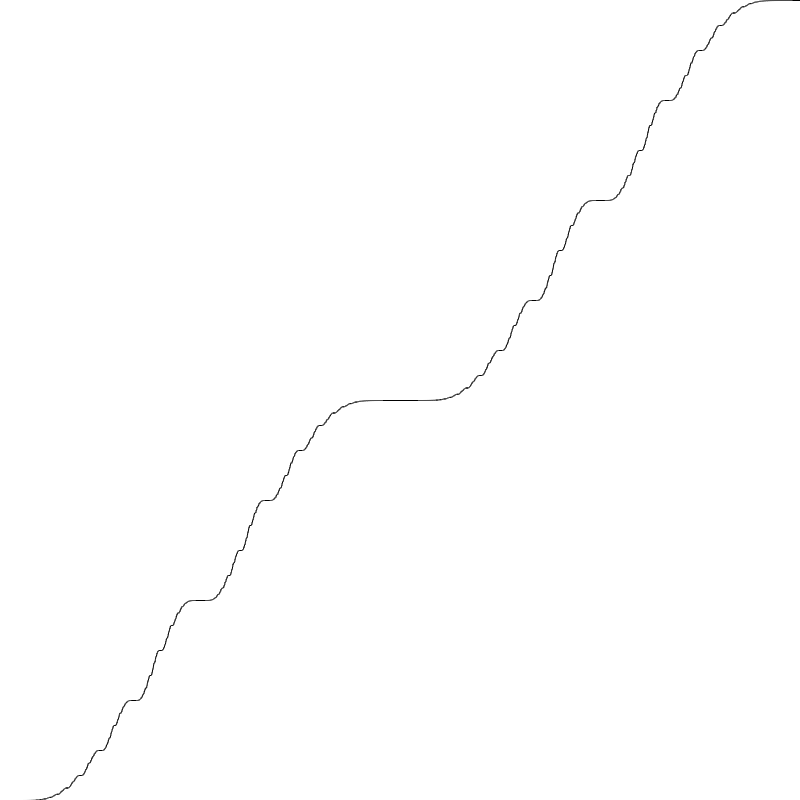
y = ?(x)

The function is known as Minkowski’s Question Mark Function (named for Hermann Minkowski). It maps irrational numbers to rational numbers and has fractal properties, it is defined as:

?(x) = a_0 + 2*\displaystyle\sum_{n=1}^\infty \frac{(-1)^{n+1}}{2^{a_1+...+a_n}}

Or:

?(x) = a_0 + 2*\displaystyle\sum_{n=1}^\infty \frac{(-1)^{n+1}}{\displaystyle\prod_{j=1}^n 2^{a_j}}

Where a_n is the n^{th} term of the continued fraction of x (only works for irrational x)

Lissajous Curves

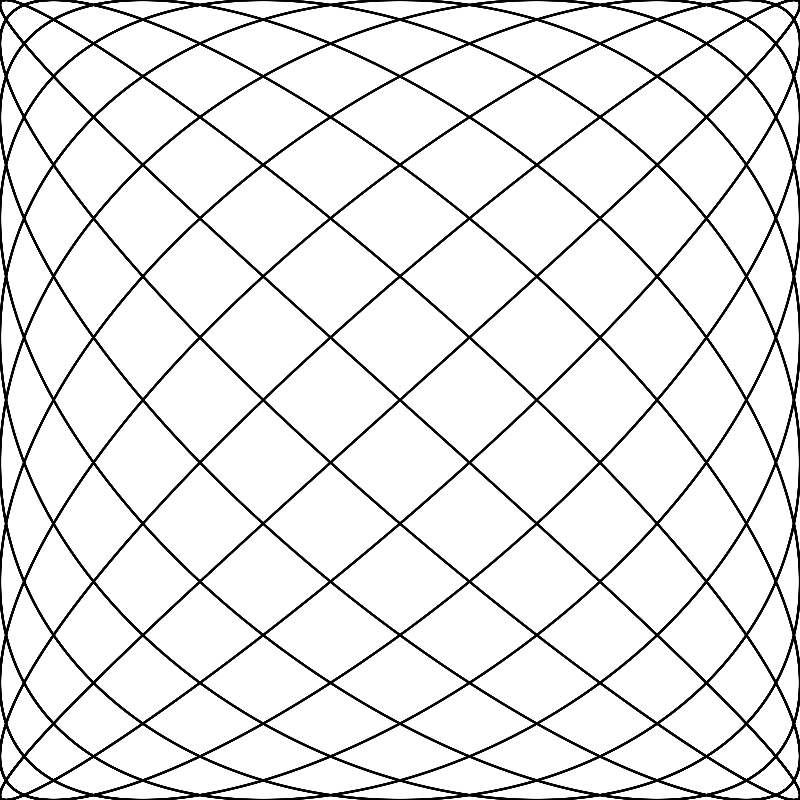
Lissajous Curves or Bowditch Curves, named for Jules Lissajous and Nathaniel Bowditch. It is a parametric system and is generated through the equations:

x = A*\sin(a*t + \delta)

y = B*\sin(b*t)

2*A and 2*B are the width and height of the final product, respectively. Higher a and b increase complexity, however Lissajous curves with ratios equivalent to smaller ratios, they are the same. For example, a = 1, b = 2 and a = 2, b = 4 produce the same curve, as \frac{1}{2} = \frac{2}{4}.

Leave a comment